Artificial intelligence (AI) has transformed graphic design, audiovisual production, and digital content creation. However, its use in creative processes has sparked ongoing debates around ethics, intellectual property, and the role of humans in creativity.
In this article, we explore the key challenges AI presents in the creative field, along with the ethical considerations needed for its responsible use.
Intellectual property and copyright
One of the biggest challenges in integrating AI into creative processes is intellectual property.
Key questions:
- Who owns an AI-generated image?
- Should copyright be granted to work created without human intervention?
- Is it legal to sell AI-generated content without modification?
Current dilemmas:
- Use of existing works: Many AI models are trained on images, music, and text created by artists without their consent
- Lack of clear regulation: In many countries, copyright laws still don’t fully address AI-generated content
- Unintentional plagiarism: Some AI outputs closely resemble existing works, raising legal concerns
Example: Some companies have published entire books with AI-generated images without crediting the artists whose work was used to train the models.
AI and the displacement of designers and creatives
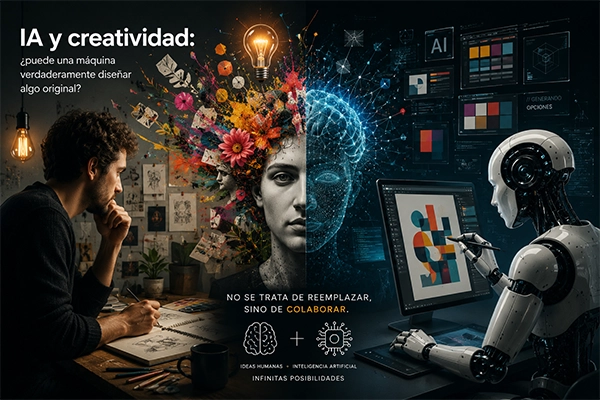
Another ethical concern is whether AI will replace professionals in design, illustration, and audiovisual production.
Will AI replace creatives?
- AI automates repetitive tasks but doesn’t replace human creativity
- Tools like DALL·E and MidJourney depend on human input and direction
- A designer’s value lies not just in execution, but in conceptual thinking and storytelling
New roles in the industry:
- Designers can specialize in prompt engineering—the craft of guiding AI through precise instructions
- Human oversight remains essential to ensure quality and accuracy
- AI can democratize design, but creative vision is still irreplaceable
Example: A designer who once spent hours sketching can now generate concepts in minutes with AI—and focus on refining the final outcome.
Lack of originality and limited creativity
Unlike human designers, AI relies on existing patterns and cannot truly generate original ideas.
Creative limitations of AI:
- It lacks intention and contextual understanding
- It depends entirely on training data
- It can produce visually appealing results, but often lacks deeper narrative
How to avoid generic design:
- Use AI as a tool for inspiration—not the final output
- Customize and refine designs with a human touch
- Avoid relying solely on AI for brand identity
Example: Many AI-generated visuals share a similar aesthetic because they are based on the same datasets and patterns.
Bias in AI models
AI systems are trained on large datasets, which means they can replicate cultural and visual biases.
Examples of bias in creative AI:
- Models that favor certain facial features over others
- Lack of diversity in generated images
- Gender and ethnic stereotypes in outputs
How to mitigate bias:
- Use AI trained on diverse and inclusive datasets
- Review and adjust outputs to avoid discrimination
- Promote ethical AI development from the ground up
Example: Some AI tools have been criticized for predominantly generating images of white individuals in professional roles.
Responsibility and transparency in AI use
It’s essential for companies and creators to be transparent about how AI is used in their work.
Best practices:
- Clearly disclose when content is generated fully or partially by AI
- Avoid misleading audiences into believing content is entirely human-made
- Respect the rights of original artists and creators
Example: Platforms like Adobe Firefly highlight that their models are trained on licensed content, helping reduce legal and ethical concerns.
How to use AI ethically in design
To ensure AI becomes an ally rather than a threat, it must be used responsibly:
- Complement, don’t replace: Use AI to support—not substitute—human creativity
- Credit creators: Acknowledge the influence of artists whose work may have trained AI models
- Avoid deceptive use: Don’t generate misleading or manipulative content
- Establish guidelines: Companies should define clear rules for AI use in content creation
Example: A design studio can use AI for initial concepts while ensuring the final output is human-crafted and tailored.
Conclusion
AI in creative processes raises important ethical challenges—from intellectual property to concerns about job displacement. However, when used responsibly, it becomes a powerful tool to enhance efficiency and elevate visual production.
The key is balance: keeping human creativity at the center while using AI as a complementary resource. As technology evolves, establishing ethical standards and regulations will be essential to ensure fair and transparent use.