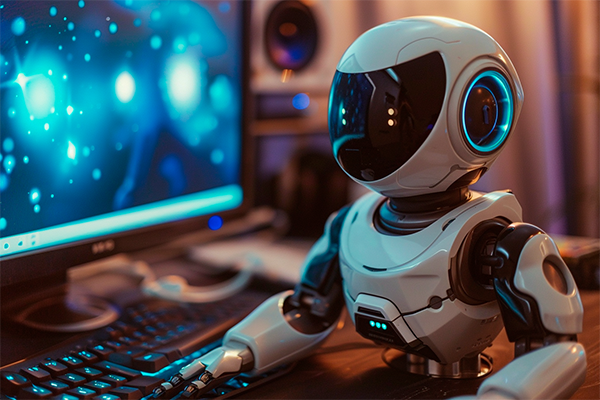
Web design has evolved with the integration of artificial intelligence (AI), enabling designers and developers to save time, improve user experience (UX), and personalize content more efficiently.
AI-powered tools have transformed how websites are built by automating processes that once required hours of manual work. In this article, we explore the top tools revolutionizing web design and how they can enhance productivity and creativity.
Automated website creation with AI
Today, it’s possible to generate fully functional websites without advanced coding knowledge thanks to AI.
Top tools:
- Wix ADI: Automatically builds websites based on user preferences
- Bookmark AiDA: AI assistant that designs websites in minutes
- 10Web AI Builder: Generates web pages from text descriptions
Advantages:
- Reduced development time
- Automatic content and design personalization
- Adaptive design without advanced coding
Example: An entrepreneur can create a complete website in minutes using Wix ADI without hiring a designer.
AI in UX/UI optimization
User interface (UI) and user experience (UX) design have improved thanks to AI, which analyzes behavior patterns and suggests real-time improvements.
Top tools:
- Adobe Sensei: Identifies design patterns and enhances interfaces automatically
- Figma AI: Provides recommendations for design and accessibility improvements
- Uizard: Converts sketches into functional interfaces
Benefits:
- More intuitive and engaging interfaces
- Real-time user experience analysis
- Automated adjustments without manual effort
Example: Designers can receive real-time suggestions on colors, typography, and layout using Adobe Sensei.
Automated visual and multimedia content generation
Images, illustrations, and videos are essential for any website—and AI simplifies their creation and optimization.
Recommended tools:
- Runway ML: Generates images and animated videos
- DALL·E 2: Creates illustrations from text prompts
- Lumen5: Converts blog posts into engaging videos
Advantages:
- High-quality visual content in minutes
- Automatic format adaptation across platforms
- Reduced production costs
Example: A blog can turn its articles into animated videos using Lumen5.
AI-powered chatbots and virtual assistants
Chatbots have improved website interaction by providing automated customer support and personalized responses.
Recommended platforms:
- Drift: Advanced conversational chatbots
- ChatGPT API: Custom AI assistant for any website
- Tidio: Chatbots integrated with e-commerce and CRM
Benefits:
- Instant responses to user inquiries
- Automated customer support processes
- Personalized interactions with visitors
Example: An e-commerce store can use Tidio to answer FAQs about shipping and products in real time.
SEO and data analysis with AI
AI has also transformed SEO by enabling real-time data analysis to improve website visibility.
AI-powered SEO tools:
- SurferSEO: Builds content strategies based on trends and keywords
- Clearscope: Analyzes content and suggests optimization improvements
- MarketMuse: Evaluates content quality and enhances SEO strategy
Benefits:
- Advanced keyword and trend analysis
- Real-time content optimization suggestions
- Improved search rankings through automated adjustments
Example: A travel blog can use SurferSEO to identify high-performing keywords and increase organic traffic.
Personalizing user experience with AI
AI allows websites to deliver personalized experiences based on user behavior and preferences.
Top tools:
- Personyze: Personalizes content based on user behavior
- Dynamic Yield: Adjusts website elements to improve conversions
- Optimizely: Runs A/B tests and adapts content for different audiences
Advantages:
- Personalized experiences for each user
- Increased retention and engagement
- Automated optimization of content and offers
Example: An e-commerce site can display recommended products based on a user’s browsing history using Dynamic Yield.
Common mistakes when using AI in web design
While AI offers powerful advantages, improper use can negatively impact website quality.
- Lack of human oversight: AI should enhance creativity, not replace it
- Over-automation: Fully AI-generated sites may lack unique identity
- Ignoring performance optimization: Some AI tools add heavy scripts that slow down the site
- No A/B testing: Not all AI suggestions are effective—testing is essential
Example: A website overloaded with automation may feel impersonal and lose its human touch.
Conclusion
AI-powered tools have revolutionized web design, enabling faster development, improved UX, personalized content, and automation of repetitive tasks. From automated website builders to chatbots and AI-driven SEO tools, these innovations have made web design more accessible and efficient.
However, maintaining a balance between automation and human creativity is essential to deliver unique and effective web experiences. AI is a powerful tool—but its implementation must be strategic and aligned with user needs.