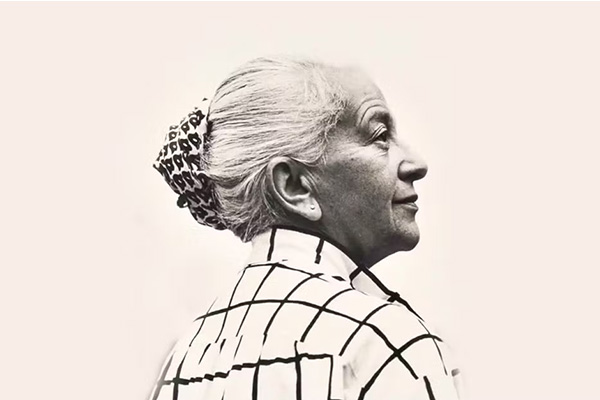
In an editorial world dominated by men, Cipe Pineles didn’t just break through—she reshaped the landscape of graphic design history.
She became the first woman to lead design at major American magazines, shaping the visual culture of an entire century.
Long before gender perspective became a common conversation in creative industries, Pineles was already proving through her work that editorial design could have a feminine perspective, aesthetic depth, and a voice of its own.
At Esbozo, we recognize her legacy as a foundational pillar of modern graphic design—and especially of the space women now occupy in creative leadership.
Who Was Cipe Pineles?
Cipe Pineles was born in 1908 in Austria-Hungary and emigrated to the United States as a child.
She studied at Pratt Institute and, after years of working her way up as an assistant, became one of the first women hired as a graphic designer at Vogue in the 1930s.
She later worked for Glamour, Seventeen, Charm, and Mademoiselle—redefining magazine design from within.
Her visual and conceptual approach wasn’t just refined and avant-garde—it was empathetic and deeply connected to real readers.
In 1943, she became the first woman admitted into the prestigious Art Directors Club of New York.
Revolution Without Breaking: The Power of Transforming from Within
Unlike disruptive designers who break rules, Pineles transformed the system quietly—through refined, modern, and intelligent design.
Her work was defined by:
- Elegant yet bold typography that interacted with content
- Layouts with rhythm and clear hierarchy
- Sophisticated, feminine color palettes without clichés
- Photography and art as central elements
- Collaborations with emerging artists and illustrators
She didn’t design to decorate—she designed to elevate the reader’s experience.
And she succeeded.
Designing for Real Women
During her time at Seventeen and Charm, Pineles moved away from the patriarchal portrayal of women as decorative figures.
Her vision was clear:
To design publications for real women—women who worked, studied, thought, and made decisions.
In the 1940s and 50s, this was a quiet revolution.
Her work helped shape a more human, powerful, and diverse image of women in postwar visual culture.
Editorial Design as Art
Pineles was also a pioneer in integrating fine art into editorial design.
She collaborated with artists like Andy Warhol and Ben Shahn before they became widely known.
She treated layout as a narrative canvas—where every element had purpose, not just decoration.
At a time when design was seen as purely technical, Pineles proved it could be expressive and artistic.
The Overlooked Legacy (and Its Rediscovery)
Despite her massive influence, Pineles’ name was largely absent from design history books for decades.
That changed in the 1990s with the rise of feminist design studies.
In 2015, her illustrated recipe book Leave Me Alone with the Recipes, originally created in the 1940s, was rediscovered—revealing her graphic sensitivity even in everyday contexts.
Lessons Cipe Pineles Leaves for Today’s Designers
At Esbozo, we believe her work remains deeply relevant. These are some of the principles we carry forward:
- Design with empathy → think about real people
- Reclaim aesthetics without stereotypes → femininity is not weakness
- Design with context → every piece responds to time, audience, and intention
- Integrate art and function → beauty communicates and elevates
- Take space when it’s not given → excellence creates its own place
Conclusion
The Designer Who Transformed Editorial Design from Within
Cipe Pineles was more than an art director.
She was an architect of visual narratives—a designer who connected content, aesthetics, and humanity with precision and creative depth.
Her work opened doors for generations of women designers.
Her legacy isn’t just visual—it’s political, cultural, and deeply inspiring.
At Esbozo, we believe looking back at figures like Pineles is how we design better today.
Because understanding where we come from
is the only way to build where we’re going.