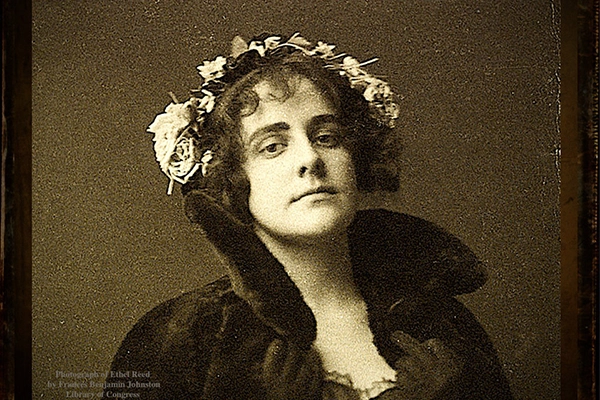
In an era dominated by men and rigid decorative styles, Ethel Reed dared to break the rules through printed posters. At just 20 years old, she transformed editorial graphics in the United States and paved the way for future generations of female designers.
Ethel Reed’s name doesn’t always appear in the major overviews of graphic design history. Yet her brief but intense body of work marked a turning point in American poster design—blending art, literature, and femininity in a way that still feels strikingly modern today.
This article is both a tribute to her legacy and an invitation to rediscover her perspective—bold, free, and deeply expressive—within the context of contemporary design.
Who Was Ethel Reed?
Ethel Reed was born in 1874 in New England, USA. Her career took off at just 19, when she began publishing illustrations in Boston magazines and newspapers. Soon after, she was hired by the publishing house Copeland & Day, where she created some of the most innovative posters of American modernism.
In just four years (1894–1898), Reed developed a unique visual language—merging Art Nouveau’s flowing lines with an emotional, melancholic, and distinctly feminine aesthetic that challenged the visual norms of her time.
A Visual Style Ahead of Its Time
Her posters weren’t just promotional tools. Each piece was a poetic composition—charged with symbolism, character, and emotion.
Key traits of her work:
- Organic, flowing lines inspired by nature
- Women portrayed as introspective or defiant
- Limited yet powerful color palettes
- Seamless integration of typography and image
- Suggestive scenes rather than explicit messages
Her style stood in stark contrast to the commercial posters of the era, often overloaded with direct messaging and industrial aesthetics. Reed didn’t design just to sell—she designed to evoke.
Graphic Design with a Gender Perspective (Before It Had a Name)
Ethel Reed was among the first to depict women as complex, real individuals in graphic design—reflective, vulnerable, powerful.
This alone was a radical act.
In her posters, women were not decorative objects but central subjects of the narrative. Instead of selling products, her characters seemed to tell inner stories—always with a gaze full of intention.
Today, we talk about inclusive design, gender perspective, and critical visual narratives. Reed was already doing it—intuitively—within a modernism that had yet to fully include women’s voices.
Notable Works
Some of Ethel Reed’s most iconic pieces include:
- The Yellow Book (1895): A poster for the American edition of the British magazine. A solitary, elegant woman looks out from a window in a moment frozen in time.
- Is Polite Society Polite? (1896): A bold book cover for Julia Ward Howe, featuring expressive use of negative space.
- The Diary of a Saint (1897): A haunting composition where a female face emerges from dark, painterly strokes.
These works didn’t just promote literature—they were art.
A Brief but Powerful Legacy
Ethel Reed disappeared from the design world at just 24. The reasons remain unclear—some suggest social pressure, financial struggles, or mental health challenges.
After moving to Europe, her work faded into silence.
She died in 1912 at the age of 38, under poorly documented circumstances. But her influence resurfaced in the late 20th century, when feminist and design historians reclaimed her as a pioneer of modern poster design and a key female voice in visual culture.
Why Ethel Reed Still Matters Today
- In a world saturated with visual noise, she reminds us of the power of subtlety, pause, and intentional gaze
- In an industry still pushing for gender equity, she proves that talent was always there—it just wasn’t always recognized
- In the age of AI and automation, her work reminds us to create with soul—not just technique
Conclusion
A Designer Who Didn’t Illustrate Books—She Illustrated Emotions
Ethel Reed wasn’t just an illustrator. She was a visual storyteller—an artist who understood that every poster could be a narrative, a window, a statement.
At Esbozo, we celebrate figures like her because they remind us that design is not decoration—it’s expression, perspective, and transformation.
Let her work keep speaking.
Let her legacy stay alive.
And let design, as Ethel Reed practiced it, remain an act of aesthetic courage.