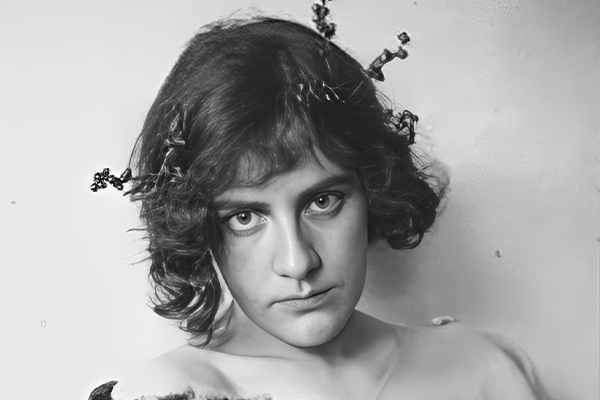
At a time when women had little space in the professional art world, Ethel Reed broke boundaries and left an unforgettable mark on the history of graphic design. Her style—both irreverent and sophisticated—blended the delicacy of Art Nouveau with a modern, distinctly feminine sensibility, creating a visual language that challenged Victorian conventions and opened the door to new aesthetic narratives.
A Brief but Intense Career
Born in 1874 in New England, Reed began her artistic career in Boston in the mid-1890s. Despite being largely self-taught, she quickly earned the respect of the city’s editorial circles, working for literary magazines, newspapers, and publishers such as Copeland & Day. Her rise was meteoric: in just three years, she produced more than 25 recognized posters and illustrations, many of them accompanying works by contemporary authors like Oscar Wilde and George Moore.
Style and Graphic Innovation
What set Ethel Reed apart from her contemporaries was not only her gender, but her ability to transform the graphic norms of her time. Rather than reproducing the ideals of submission and domesticity imposed on women, her female figures were autonomous, introspective—even mysterious. She used flowing lines, bold compositions, and typography integrated into the artwork as part of the narrative.
Her pieces carried a dreamlike quality, where the female face—often self-referential—became the focal point, challenging the passive role assigned to women in the advertising imagery of the era. In a world dominated by male academic traditions, Reed proposed a form of design where beauty was not an object, but a subject.
Beyond the Poster: A Cultural Icon
Ethel Reed was not only a designer—she also wrote, expressed opinions, and actively participated in progressive intellectual circles. Her public persona sparked attention: young, independent, creative, and bohemian. She became a cultural symbol of the modern woman transitioning into the 20th century—both admired and criticized.
However, her career was short-lived. In the late 1890s, she moved to Europe and largely disappeared from public view. It is known that she faced financial and personal struggles, and she died prematurely in 1912 at just 38 years old. Her work, however, has been rediscovered by design historians and feminist scholars as a key contribution to modern poster design.
Legacy and Impact
Ethel Reed is an essential figure for understanding graphic design not only as a technical discipline, but also as a cultural and political one. She was a pioneer who demonstrated that visual art can be a form of resistance and personal expression. Today, her work is featured in exhibitions, academic research, and publications that recognize not only her aesthetic talent, but her courage in challenging established norms.
In an era when women rarely signed their work, Ethel Reed signed hers with style, strength, and vision. Her legacy endures as an inspiration for graphic designers who, like her, understand that the power of design begins when there is something meaningful to say.