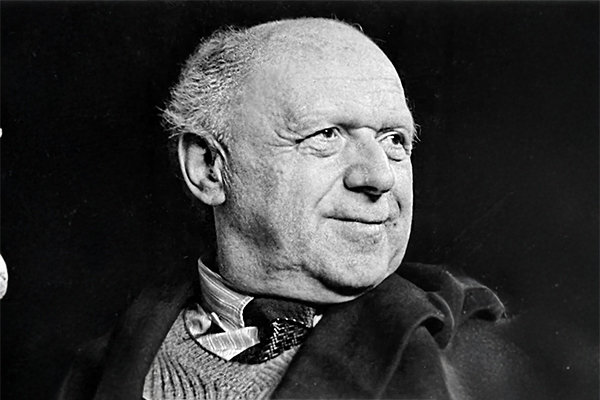
Before dashboards, data visualization tools, or interactive maps existed, Otto Neurath was already designing a visual language to help the world understand itself.
An Austrian philosopher, sociologist, and economist, Neurath wasn’t a designer in the traditional sense—but his impact on graphic design and information design is undeniable. His ISOTYPE system (International System of Typographic Picture Education) laid the foundation for modern infographics and transformed how we communicate data.
At Esbozo, we recognize his legacy as one of the pillars of our practice: designing to inform, to educate, and to empower.
Who was Otto Neurath?
Otto Neurath was born in Vienna in 1882. He was a multidisciplinary thinker, working across economics, sociology, statistics, education, and philosophy of science.
He was also part of the Vienna Circle, a group advocating logical positivism—the idea that knowledge should be verifiable and accessible.
In the 1920s, driven by the need to democratize knowledge, Neurath proposed a simple but radical idea:
👉 If we want to educate everyone, we must use images.
That idea became ISOTYPE.
ISOTYPE: a universal visual language
ISOTYPE (International System of Typographic Picture Education) is a graphic system based on simple, standardized pictograms designed to represent quantitative data and complex ideas.
📊 Instead of dense numbers or long text, ISOTYPE used repeated icons to communicate:
- Population statistics
- Industrial and agricultural production
- Mortality rates
- Migration patterns
- Economic indicators
Its principles were clear:
- Clarity over ornament
- One image = one idea
- Visual consistency for easy comparison
- Avoid realism and ambiguity
- Designed for mass education
It was the first serious attempt to create a universal visual literacy system.
Collaboration: the role of Gerd Arntz
While Neurath defined the system, Gerd Arntz brought it to life visually.
He created over 4,000 pictograms—simple, geometric, monochrome, and direct.
Together with Marie Neurath, they turned ISOTYPE into a global educational tool used in exhibitions, publications, and schools.
This collaboration is a perfect example of what happens when strategy meets design.
Design with purpose: education and social transformation
Neurath’s goal wasn’t aesthetic—it was educational and political.
He believed that access to knowledge was essential for building a fairer society.
ISOTYPE was designed to:
- Break language barriers
- Overcome illiteracy
- Make complex information accessible to everyone
Today, we could call him a precursor of:
- Inclusive design
- UX thinking
- Data visualization
Legacy in contemporary design
Many elements we take for granted today are rooted in Neurath’s work:
- Pictograms and signage (airports, public systems)
- Editorial infographics
- Digital dashboards
- Data visualization platforms
- Interfaces that communicate without text
His methodology also influenced:
- Information design as a discipline
- Systems thinking in design
- Visual communication as a learning tool
What Otto Neurath teaches us at Esbozo
We see his vision as a guiding principle:
- Design to explain, not to impress
- Achieve clarity with minimal elements
- Turn data into understanding
- Build systems, not isolated pieces
- Value interdisciplinary collaboration
Conclusion
A visionary who turned data into understanding
Otto Neurath was a quiet pioneer who reshaped how we interpret the world.
His work with ISOTYPE is more than a milestone in design—it’s a tool for education, transparency, and empowerment.
In a time where we are overwhelmed with data, his message feels more relevant than ever:
👉 Having information is not enough.
👉 You have to know how to communicate it.
At Esbozo, we take that as a foundation:
design that doesn’t just look good—but teaches, organizes, and connects.