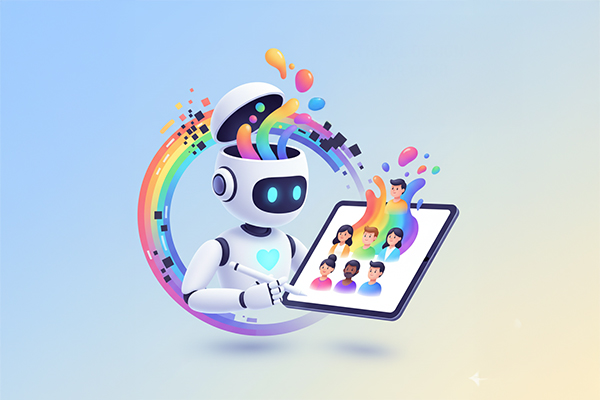
Artificial intelligence is transforming design—but it’s also replicating (and amplifying) many of our cultural, aesthetic, and social biases.
The question is no longer whether to use AI, but how to use it ethically and responsibly.
At a time when algorithms can generate full visual identities, branding proposals, web layouts, and campaigns, designers face a new challenge: becoming guardians of visual ethics.
This article explores the main risks of bias in AI-generated design, how to detect them, and how to validate your work before releasing it into the real world.
What is an AI-generated visual bias?
It’s an unintentional preference that AI learns and reproduces in visual outputs, as a direct result of the data it was trained on.
For example:
- Repetition of Western or Eurocentric aesthetics
- Limited representation of bodies, ages, genders, or ethnicities
- Stylization driven by trends rather than cultural context
- Exclusion of minority symbolism
This isn’t the AI’s “fault”—it’s the dataset behind it.
Common biases in AI-generated design
1. Homogeneous, non-diverse aesthetics
Most AI tools (Midjourney, DALL·E, Firefly) tend to generate:
- White, young, slim individuals
- Unless diversity is explicitly specified
2. Stereotypical gender representation
- Hypersexualized women
- Muscular, dominant male figures
- Traditional roles and poses
AI reinforces stereotypes if not guided intentionally.
3. Preference for dominant styles
Trends like:
- Scandinavian minimalism
- “Tech aesthetic”
…are overrepresented, while global visual cultures are underexplored.
4. Distorted cultural symbolism
Requests like “indigenous symbols” or “Asian iconography” often result in:
- Inaccurate
- Superficial
- Confused representations
AI has no cultural sensitivity—only pattern recognition.
Why ethical validation matters
- To avoid reinforcing harmful stereotypes
- To represent people with dignity
- To prevent unintentional exclusion
- To build trust in your brand
- Because design communicates values—not just visuals
A modern brand cannot afford visual bias due to speed or convenience.
How to ethically validate AI-generated design
1. Review human representation
Ask yourself:
- Are different skin tones represented?
- Are body types diverse?
- Is gender representation balanced?
- Is disability or other conditions included?
👉 Don’t prompt “people.” Be specific if you want diversity.
2. Evaluate cultural references
- Is the symbol accurate or invented?
- Is it used in context or as decoration?
- Could it be misinterpreted?
👉 Always run cultural validation before publishing.
3. Check stylistic balance
- Does it align with your brand identity?
- Does it fit your audience’s context?
- Is it just trend-driven without purpose?
AI suggests—you decide what belongs.
4. Apply human correction
Edit, refine, adjust:
- Typography
- Composition
- Representation
- Tone
Ethical post-production is your responsibility.
Ethical validation framework
| Criteria | Ethical Question | Recommended Action |
|---|---|---|
| Representation | Who appears and how? | Ensure inclusive visuals |
| Cultural context | Is this symbol accurate? | Validate with research |
| Purpose | Does it reflect brand values? | Adjust concept if needed |
| Audience | Could it exclude or offend? | Test before launch |
The designer’s role in the age of AI
AI has no awareness. No empathy. No intention.
You do.
Today, designers must become:
- Curators
- Editors
- Translators between data and emotion
- Defenders of inclusion and visual ethics
At Esbozo, we use AI—but we never publish without reviewing.
Because every visual is more than aesthetic—it’s positioning.
Conclusion
Designing with AI is easy. Designing with ethics is essential.
Using AI isn’t the problem.
Using it without judgment is.
As designers, we’re responsible for ensuring that what we create reflects the world we want to build:
More inclusive. More respectful. More conscious.
So every time you use AI, ask yourself:
🔎 Does this truly represent the people I’m speaking to?
Because in design—as in everything—ethics isn’t optional.
It’s part of the craft.