Creativity is one of the most highly valued human qualities, a process that has historically been difficult for machines to replicate. With advances in artificial intelligence (AI) across various disciplines, one of the most fascinating and controversial questions that arises is: can AI create something truly original? In this article, we explore the limits of AI in design and question whether machines can surpass human creativity or simply replicate existing patterns.
The Rise of Artificial Intelligence in Design
Artificial intelligence has advanced rapidly in recent decades, transforming industries and changing the way we interact with technology. In the field of graphic design, AI is beginning to have a significant impact, from logo creation to the generation of complex images and patterns. However, the fundamental question remains whether AI can truly be creative or if it simply follows pre-existing algorithms and patterns.
AI in Graphic Design: From Automation to Creation
Initially, machines in graphic design were tools used to automate repetitive tasks, such as image adjustment or the creation of simple patterns. However, with the advent of advanced algorithms and neural networks, AI now has the ability to generate more complex designs, ranging from advertising posters to artistic illustrations. But can these designs be considered “creative”? Or are they simply variations of what has already been done before?
Is Human Creativity Beyond the Reach of Machines?
Human creativity is complex and influenced by experiences, emotions, and cultural contexts. Machines, though incredibly powerful, lack these personal experiences. In this sense, human creativity is unique in its ability to generate completely new ideas, often driven by intuition, emotion, and context. Meanwhile, AI remains dependent on prior data and existing patterns. This fundamental difference raises the question of whether a machine can truly surpass human creativity or if it is doomed to replicate what has already been created.
AI in Design: Creativity or Pattern Imitation
One of the main criticisms of AI in graphic design is that, no matter how advanced its algorithms may be, machines still rely on existing data. AI can generate new designs based on learned patterns, but it is not creating something completely “original” in the human sense of the term. So, can we really talk about creativity when a machine produces something inspired solely by what has already been created by humans?
Neural Networks and Deep Learning in Design
Neural networks and deep learning are two technologies that have enabled machines to learn from large amounts of data and generate increasingly sophisticated results. However, AI still depends on the information it is provided. AI systems can analyze thousands of works of art, graphics, and other designs to identify patterns and trends, but these systems are operating within the limits set by the input data. This raises the question: can AI truly be creative if it is merely replicating pre-existing patterns?
The Difference Between Algorithmic Creativity and Human Creativity
Human creativity involves the ability to break through established boundaries, experiment, and think outside the box. Human designers can combine ideas from different disciplines, blend cultural and emotional influences, and create something that has never been seen before. Meanwhile, AI, while capable of producing visually appealing work, does so within the confines of what it has learned, lacking the capacity for genuine innovation.
Can AI surpass human creativity in design?
Although AI has the potential to create impressive results, the key question is whether it can reach a level of originality comparable to that of a human. Human creativity is more than just the combination of patterns, as it is driven by emotion, experience, and intuition. Machines, on the other hand, lack these capabilities, but they remain powerful tools that can complement the human creative process.
H3: AI as a Collaborator in the Creative Process
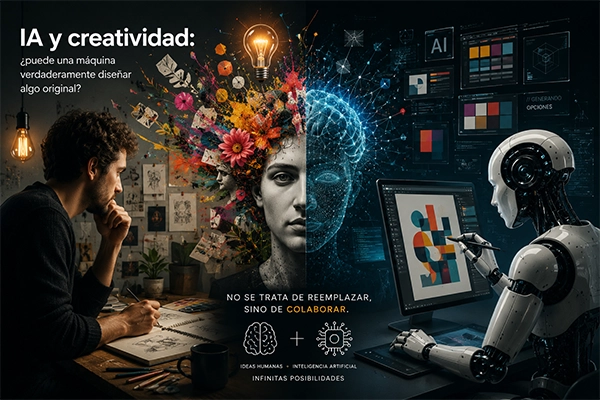
Rather than viewing AI as competition for designers, it is more useful to consider it a collaborative tool. Designers can use AI to generate initial ideas, explore combinations of colors, shapes, and patterns, and then make creative decisions based on those results. In this sense, AI can serve as a “creative assistant,” offering fresh perspectives and accelerating the design process, while leaving the final decision in the hands of the human designer.
The Limits of AI in Graphic Design
Although AI can be incredibly useful, it is still far from replacing human creativity. Graphic designers don’t just create visual products; they create experiences that resonate emotionally with audiences. The ability to understand culture, context, and human emotions is something that AI cannot yet replicate. Therefore, while AI can generate interesting designs, human creativity remains essential for truly connecting with the audience.
The Future of Creativity in Design: A Collaboration Between Humans and Machines
The future of graphic design appears to be a collaboration between human creativity and artificial intelligence. Rather than replacing designers, AI will offer new tools and possibilities that will allow creatives to explore uncharted territory and develop more complex and sophisticated ideas. AI could become a “digital brush,” helping designers experiment faster and with greater precision, but always under the guidance of a human vision.
AI as an extension of human creativity
In the future, AI will not compete with human creativity; it will enhance it. Designers will learn to use AI as an extension of their own capabilities, integrating the technology into their workflow to improve efficiency and innovation. This will create a symbiosis where machines help humans explore more ideas and take their concepts beyond what was previously possible.
Ethics and the Future of AI-Assisted Creativity
As AI plays an increasingly important role in graphic design, new ethical questions will arise, such as the intellectual property rights of machine-generated designs and the possibility that machines might replicate human work without proper credit. The future of AI-assisted creativity will depend on how designers and companies handle these issues, ensuring that machines complement human creativity without replacing it.
Conclusion: AI Creativity—A Shared Future with Designers?
Artificial intelligence holds great potential in the field of graphic design, but it is unlikely to replace human creativity. Rather, AI offers an opportunity for designers to expand their horizons, accelerate their creative process, and experiment with new ideas. Authentic and emotionally resonant creativity remains a uniquely human quality, and AI can be a powerful tool to help designers explore new possibilities without losing the essence of human creativity.
A Collaborative Future Between Humans and Machines
The future of graphic design will be shaped by the collaboration between human creative abilities and powerful AI tools. Rather than competing, the two will work together to create more innovative, complex, and meaningful designs. Thus, human creativity and artificial intelligence will coexist, complementing one another and opening up new frontiers in the world of design.